
Palavras-chave
pensamento crítico
notícias falsas
alfabetização midiática
ciência
Como Citar




Resumo
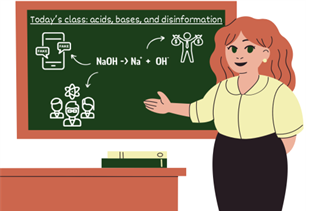
Este trabalho tem como base a premissa de que o tratamento da desinformação científica e da desinformação sobre as teorias ácido-base requer uma abordagem multidisciplinar, aproximando o conhecimento sobre ácido-base do conteúdo normalmente não abordado nas aulas de química. Partindo desse princípio, este artigo analisa como as publicações revisadas por pares para o ensino de química abordam a representação das teorias ácido-base no contexto de distúrbios informacionais (desinformação e desinformação) por meio de uma revisão da literatura e análise textual. Os artigos analisados abordam casos de distúrbios informativos por meio de uma lente disciplinar, com ênfase acentuada no recurso a conteúdos ácido-base para desmascarar mensagens errôneas, embora os contextos explorados façam referência a questões sociocientíficas. Como resposta, este artigo amplia a conservação, propondo outros conteúdos que também poderiam transmitir a natureza da ciência, o funcionamento da mídia tradicional e moderna, além de valores e ideologias. Ao fazer isso, este artigo fornece mais elementos para leituras críticas e mais amplas das teorias ácido-base em distúrbios informacionais, elevando o ensino de química para melhor abordar os desafios contemporâneos decorrentes da interação entre ciência e mídia.Referências
Algarra, R. V. M.; Zamora, L. L.; Fos, G. M. A.; López, P. A. A. Magnetized Water: Science or Fraud? Journal of Chemical Education. 2008, 85 (10), 1416–1418. https://doi.org/10.1021/ed085p1416
Allchin, D. What Counts as Science. The American Biology Teacher. 2012, 74 (4), 291–294. https://doi.org/10.1525/abt.2012.74.4.17
Allchin, D. From Test Tubes to Youtube: Nature of Science in Socioscientific Issues and History. In Emerging Computacional Media and Science Education. 2015.
Allchin, D. Who Speaks for Science? Science & Education. 2021, 31, 1475–1492. https://doi.org/10.1007/s11191-021-00257-4
Arroio, A. Is Media Literacy an Urgent Issue in Education for All? Problems of Education in the 21st Century. 2017, 75 (5), 416–418. https://doi.org/10.33225/pec/17.75.416
Arroio, A. The value of education in the context of Covid-19 pandemic. Problems of Education in the 21st Century. 2020, 78 (3), 309–313. https://doi.org/10.33225/pec/20.78.309
Aromataris, E.; Pearson, A. The Systematic Review: An Overview. AJN, American Journal of Nursing. 2014, 114 (3), 53–58. https://doi.org/10.1097/01.NAJ.0000444496.24228.2c
Belova, N.; Chang Rundgren, S.-N.; Eilks, I. Advertising and Science Education: A Multi-Perspective Review of the Literature. Studies in Science Education. 2015, 51 (2), 169–200. https://doi.org/10.1080/03057267.2015.1049444
Belova, N.; Eilks, I. Learning with and about Advertising in Chemistry Education with a Lesson Plan on Natural Cosmetics – a Case Study. Chemistry Education Research and Practice. 2015, 16 (3), 578–588. https://doi.org/10.1039/c5rp00035a
Bimber, B.; Zúñiga, G. H. The Unedited Public Sphere. New Media & Society. 2020, 22 (4), 700–715. https://doi.org/10.1177/1461444819893980
Boulware, L. Ebony.; Cooper, L. A.; Ratner, L. E.; LaVeist, T. A.; Powe, N. R. Race and Trust in the Health Care System. Public Health Reports. 2003, 118 (4), 358–365. https://doi.org/10.1016/s0033-3549(04)50262-5
Campos, R. C.; Silva, R. C. Funções Da Química Inorgânica ...Funcionam? Química nova na Escola. 1999, (9), 18–22.
Cardoso, D.; Gurgel, I. Por Uma Educação Científica Que Problematize a Mídia. Linhas Críticas. 2019, 25, 74–93. https://doi.org/10.26512/lc.v25.2019.19850
Covitt, B. A.; Anderson, C. W. Untangling Trustworthiness and Uncertainty in Science. Science & Education. 2022, 31, 1155–1180. https://doi.org/10.1007/s11191-022-00322-6
Cunha, M. B. A Química “Mal Dita” em Fake Science. Revista de Ensino de Ciências e Matemática. 2021, 12 (6), 1–25. https://doi.org/10.26843/rencima.v12n6a09
Das, R.; Ahmed, W. Rethinking Fake News: Disinformation and Ideology during the Time of COVID-19 Global Pandemic. IIM Kozhikode Society & Management Review. 2021, 11 (1), 146–159. https://doi.org/10.1177/22779752211027382
Drechsler, M.; Van Driel, J. Experienced Teachers’ Pedagogical Content Knowledge of Teaching Acid–Base Chemistry. Research in Science Education. 2007, 38 (5), 611–631. https://doi.org/10.1007/s11165-007-9066-5
Dodds, R. E.; Tseëlon, E.; Weitkamp, E. L. C. Making Sense of Scientific Claims in Advertising. A Study of Scientifically Aware Consumers. Public Understanding of Science. 2008, 17 (2), 211–230. https://doi.org/10.1177/0963662506065559
Feinstein, N. W.; Waddington, D. I. Individual Truth Judgments or Purposeful, Collective Sensemaking? Rethinking Science Education’s Response to the Post-Truth Era. Educational Psychologist. 2020, 55 (3), 155–166. https://doi.org/10.1080/00461520.2020.1780130
Furió-Más, C.; Calatayud, M. L.; Guisasola, J.; Furió-Gomez, C. How Are the Concepts and Theories of Acid–Base Reactions Presented? Chemistry in Textbooks and as Presented by Teachers. International Journal of Science Education. 2005, 27 (11), 1337–1358. https://doi.org/10.1080/09500690500102896
Funk, S.; Kelnner, D.; Share, J. Critical Media Literacy as Transformative Pedagogy. In Journalism and Ethics: Breakthroughs in Research and Practice; IGI Global, 2019; pp 318–348.
Ghinea, G.; Cardoso, S. G.; Caparelli, M. C. M. Case Study: Fake News and Threats to Brazilians’ Health. In: Fake news in an era of social media: tracking viral contagion. Ibrahim, Y., Safieddine, F., Eds.; Rowman & Littlefield, 2020; pp 59–72.
Hauge, K. H. A Tool for Reflecting on Questionable Numbers in Society. Studies in Philosophy and Education. 2022, 41 (5), 511–528. https://doi.org/10.1007/s11217-022-09836-6
Höttecke, D.; Allchin, D. Reconceptualizing Nature of Science Education in the Age of Social Media. Science Education. 2020, 104 (4), 641–666. https://doi.org/10.1002/sce.21575
Kahan, D. M.; Peters, E.; Wittlin, M.; Slovic, P.; Ouellette, L. L.; Braman, D.; Mandel, G. The Polarizing Impact of Science Literacy and Numeracy on Perceived Climate Change Risks. Nature Climate Change. 2012, 2 (10), 732–735. https://doi.org/10.1038/nclimate1547
Kellner, D.; Share, J. The Critical Media Literacy Guide: Engaging Media and Transforming Education; Brill Sense, 2019.
Kovach, B.; Rosenstiel, T. Blur: How to Know What’s True in the Age of Information Overload; Bloomsbury, 2011.
Lima, C.; Moradillo, E. F. Ácidos e Bases nos Livros Didáticos: ainda Duas das Quatro Funções da Química Inorgânica? Química Nova na Escola. 2019, 41 (3), 242–247. https://doi.org/10.21577/0104-8899.20160167
Locatelli, S. W. Reflecting upon Fake News in Today’s Post-Truth Era. Problems of Education in the 21st Century. 2021, 79 (4), 513–515. https://doi.org/10.33225/pec/21.79.513
Lu, J.; Zhang, M.; Zheng, Y.; Li, Q. Communication of Uncertainty about Preliminary Evidence and the Spread of Its Inferred Misinformation during the COVID-19 Pandemic—a Weibo Case Study. International Journal of Environmental Research and Public Health. 2021, 18 (22), 1–17. https://doi.org/10.3390/ijerph182211933
Miller, J.; Rost, L.; Bryant, C.; Embry, R.; Iqbal, S.; Lannoye-Hall, C.; Oslon, M. Media Literacy in the Age of Covid and Climate Change. The Science Teacher. 2021, 88 (6), 20–30.
Oreskes, N. Why Trust Science? Princeton University Press, 2019.
Oreskes, N.; Conway, E. M. Merchants of Doubt: How a Handful of Scientists Obscured the Truth on Issues from Tobacco Smoke to Global Warming; Bloomsbury, 2010.
Osborne, J.; Pimentel, D. Science Education in an Age of Misinformation. Science Education. 2023, 107 (3), 553–571. https://doi.org/10.1002/sce.21790
Oxford Languages. Oxford Word of the Year 2016; Oup.com, 2016. https://languages.oup.com/word-of-the-year/2016/ (accessed 2024-12-26).
Pivaro, G. F.; Girotto Júnior, G. O Ataque Organizado à Ciência como Forma de Manipulação: do Aquecimento Global ao Coronavírus. Caderno Brasileiro de Ensino de Física. 2020, 37 (3), 1074–1098. https://doi.org/10.5007/2175-7941.2020v37n3p1074
Reid, G.; Norris, S. P. Scientific Media Education in the Classroom and Beyond: A Research Agenda for the Next Decade. Cultural Studies of Science Education. 2015, 11 (1), 147–166. https://doi.org/10.1007/s11422-015-9709-1
Ribeiro, F. V.; de Oliveira Amorim, A. P.; Silva Lopes, C. Discutindo Fake News sobre Química Durante a Pandemia da COVID-19. Revista Thema. 2022, 21 (2), 387–401. https://doi.org/10.15536/thema.v21.2022.387-401.2176
Rosenberg, J. M.; Kubsch, M.; Wagenmakers, E.-J.; Dogucu, M. Making Sense of Uncertainty in the Science Classroom. Science & Education. 2022, 31 (5), 1239–1262. https://doi.org/10.1007/s11191-022-00341-3
Santos, W. L. P. dos. Educação Científica Na Perspectiva de Letramento como Prática Social: Funções, Princípios e Desafios. Revista Brasileira de Educação. 2007, 12 (36), 474–492. https://doi.org/10.1590/s1413-24782007000300007
Schulz, A.; Roessler, P. The Spiral of Silence and the Internet: Selection of Online Content and the Perception of the Public Opinion Climate in Computer-Mediated Communication Environments. International Journal of Public Opinion Research. 2012, 24 (3), 346–367. https://doi.org/10.1093/ijpor/eds022
Shaheen, N.; Shaheen, A.; Ramadan, A.; Hefnawy, M. T.; Ramadan, A.; Ibrahim, I. A.; Hassanein, M. E.; Ashour, M. E.; Flouty, O. Appraising Systematic Reviews: A Comprehensive Guide to Ensuring Validity and Reliability. Frontiers in Research Metrics and Analytics. 2023, 8 (8), 1–9. https://doi.org/10.3389/frma.2023.1268045
Siqueira, F.; Arroio, A. A Strategy for Addressing Fake News and Denialism in Elementary and Secondary Schools. Annales Universitatis Paedagogicae Cracoviensis. 2022, 12, 120–132. https://doi.org/10.24917/20837267.12.10
Silva, M. B.; Sasseron, L. H. Alfabetização Científica e Domínios do Conhecimento científico: Proposições para uma Perspectiva Formativa Comprometida com a Transformação Social. Ensaio Pesquisa em Educação em Ciências, 2021, 23 (e34674), 1–20. https://doi.org/10.1590/1983-21172021230129
Silva, E. M. dos S.; Arroio, A. Science Literacy in the Age of Disinformation: Building Bridges to Address the Complexity of the Challenge. In Media and information literacy for the public good: UNESCO MILID Yearbook 2023.; Jaakkola, M., Tomás, D.-B., Bosire Onyancha, O., Eds.; Corporación Universitaria Minuto de Dios - UNIMINUTO, 2023; pp 81–100.
Silva, E. M. dos S.; Arroio, A. Letramento Midiático na Formação de Licenciandos em Ciências da Universidade de São Paulo: o que Revelam as Ementas? Ciência & Educação (Bauru). 2025, 31 (e25015), 1-15. https://doi.org/10.1590/1516-731320250015
Souza, C. R. de; Silva, F. C. Discutindo o Contexto das Definições de Ácido e Base. Química Nova na Escola. 2018, 40 (1), 14–18. https://doi.org/10.21577/0104-8899.20160099
Souza, L. K. Pesquisa com Análise Qualitativa de Dados: Conhecendo a Análise Temática. Arquivos Brasileiros de Psicologia. 2019, 71 (2), 51–67. https://doi.org/10.36482/1809-5267.ARBP2019v71i2p.51-67
Stroppa, T. Primeiro de Abril, a Descoberta do “Boimate” e o Combate às Fake News. CartaCapital, 2018. https://www.cartacapital.com.br/blogs/intervozes/primeiro-de-abril-a-descoberta-do-201cboimate201d-e-o-combate-as-fake-news/ (accessed 2024-12-11).
Swire-Thompson, B.; Lazer, D. Reducing Health Misinformation in Science: A Call to Arms. The ANNALS of the American Academy of Political and Social Science. 2022, 700 (1), 124–135. https://doi.org/10.1177/00027162221087686
Toby, S. Chemistry in the Public Domain: A Plethora of Misinformation - or, Don’t Believe Everything You Read in the Newspapers! Journal of Chemical Education. 1997, 74 (11), 1285. https://doi.org/10.1021/ed074p1285
UNESCO. Jornalismo, “Fake News” E Desinformação. Manual Para Educação Em Jornalismo; UNESCO, 2019.
Vosoughi, S.; Roy, D.; Aral, S. The Spread of True and False News Online. Science. 2018, 359 (6380), 1146–1151. https://doi.org/10.1126/science.aap9559
Valladares, L. Post-Truth and Education. Science & Education. 2022, 31, 1311–1337. https://doi.org/10.1007/s11191-021-00293-0
Valladares, L. Scientific Literacy and Social Transformation. Science & Education. 2021, 30 (3), 557–587. https://doi.org/10.1007/s11191-021-00205-2
Wu, T. Blind Spot: The Attention Economy and the Law. Antitrust L. J. 2019, 82, 771.

Este trabalho está licenciado sob uma licença Creative Commons Attribution 4.0 International License.
Copyright (c) 2025 Eclética Química