
Keywords
matriculation
HOTS module
chemistry education
thinking skills
How to Cite




Abstract
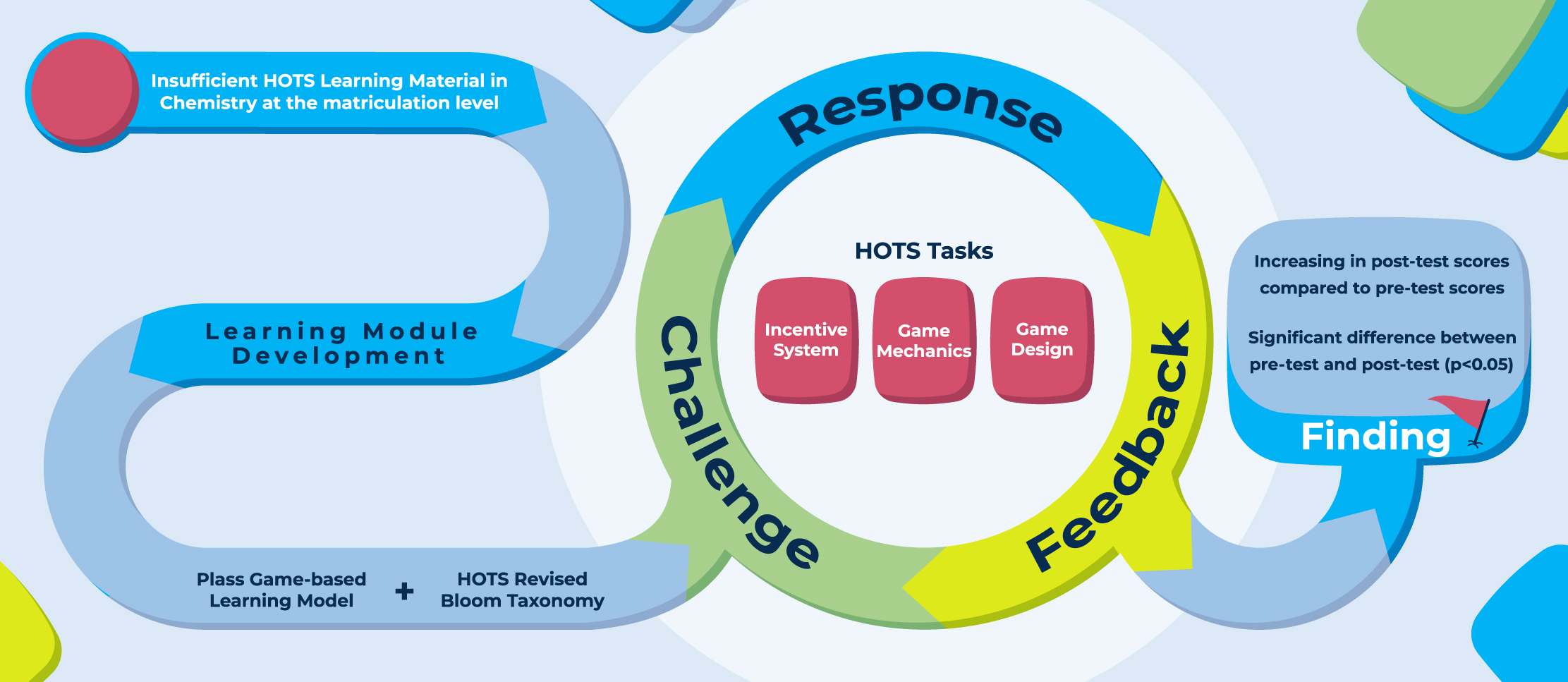
In 21st-century learning, higher-order thinking skills (HOTS) are essential for matriculation students. However, lacking HOTS materials gives students less opportunity to practice HOTS in chemistry. This research paper developed a game-based learning module based on the Revised Bloom's taxonomy and a game-based learning model. Pre-experimental design with a one-group pre-test and post-test was employed to measure the effects of the module on students' HOTS namely analyzing, evaluating, and creating thinking skills, involving 30 students at matriculation college. The result shows an increase in mean scores in post-test compared to pre-test scores and paired sample T-test shows a significant difference between pre-test and post-test scores with p<0.05. The findings contributed to the potential of game-based learning for promoting HOTS at the matriculation level and providing learners with a quality education.
References
Aini, F. Q.; Fitriza, Z.; Gazali, F.; Mawardi, M. First-year university students’ understanding of chemical equilibrium. Journal of Physics: Conference Series. 2019, 1280, 032018. https://doi.org/10.1088/1742-6596/1280/3/032018
Anderson, L. W.; Krathwohl, D. R. A Taxonomy for Learning Teaching and Assessing. A Revision of Bloom’s Taxonomy of Educational Objectives. Longman, 2001.
Azid, N.; Md-Ali, R. The effect of the successful intelligence interactive module on universiti utara malaysia students’ analytical, creative and practical thinking skills. South African Journal of Education. 2020, 40 (3), 1–11. https://doi.org/10.15700/saje.v40n3a1743
Bello, S.; Ibi, M. B.; Bukar, I. B. Effect of Simulation Techniques and Lecture Method on Students' Academic Performance in Mafoni Day Secondary School Maiduguri, Borno State, Nigeria. Journal of Education and Practice. 2016, 7 (23), 113–117.
Chen, S. Y.; Tsai, J. C.; Liu, S. Y.; Chang, C. Y. The effect of a scientific board game on improving creative problem solving skills. Thinking Skills and Creativity. 2021, 41, 100921. https://doi.org/10.1016/J.TSC.2021.100921
Cohen, L.; Manion, L.; Morrison, K. Research Methods in Education. Routledge, 2017. https://doi.org/10.4324/9781315456539
Farihah, M. J.; Norawi, A. M.; Jahan, A. N. Game-Based STEM Module Development for KSSM Science Teachers. Journal of Turkish Science Education. 2021, 18 (2), 249–262. https://doi.org/10.36681/tused.2021.63
Ichsan, I. Z.; Sigit, D. V.; Miarsyah, M.; Ali, A.; Arif, W. P.; Prayitno, T. A. HOTS-AEP: Higher order thinking skills from elementary to master students in environmental learning. European Journal of Educational Research. 2019, 8 (4), 935–942. https://doi.org/10.12973/eu-jer.8.4.935
Jamal, S. N. B.; Ibrahim, N. H. B.; Halim, N. D. B. A.; Alias, M. I. B. A preliminary study on the level of creativity among chemistry students in district of melaka tengah. Journal of Critical Reviews. 2020, 7 (16), 752–761. https://doi.org/10.31838/jcr.07.16.88
Johnson, R. B.; Christensen, L. Educational research: Quantitative, qualitative, and mixed approaches. Sage publications, 2019.
Khamhaengpol, A.; Phewphong, S.; Chuamchaitrakool, P. STEAM Activity on Biodiesel Production: Encouraging Creative Thinking and Basic Science Process Skills of High School Students. Journal of Chemical Education. 2021, 99 (2), 736–744. https://doi.org/10.1021/acs.jchemed.1c00874
Misrom, N. S.; Abdurrahman, M. S.; Abdullah, A. H.; Osman, S.; Hamzah, M. H.; Fauzan, A. Enhancing students’ higher-order thinking skills (HOTS) through an inductive reasoning strategy using geogebra. International Journal of Emerging Technologies in Learning. 2020, 15 (3), 156–179. https://doi.org/10.3991/ijet.v15i03.9839
Noh, S. C.; Karim, A. M. A. Design thinking mindset to enhance education 4.0 competitiveness in Malaysia. International Journal of Evaluation and Research in Education. 2021, 10 (2), 494–501. https://doi.org/10.11591/ijere.v10i2.20988
Patiño, A.; Ramírez-Montoya, M. S.; Buenestado-Fernández, M. Active learning and education 4.0 for complex thinking training: analysis of two case studies in open education. Smart Learning Environments. 2023, 10 (8). https://doi.org/10.1186/s40561-023-00229-x
Plass, J. L.; Homer, B. D.; Kinzer, C. K. Foundations of Game-Based Learning. Educational Psychologist. 2015, 50 (4), 258–283. https://doi.org/10.1080/00461520.2015.1122533
Plass, J. L.; Homer, B. D.; Mayer, R. E.; Kinzer, C. K. Theoretical Foundations of Game-Based and Playful Learning. In Handbook of game-based learning. 2020.
Rokhim, D. A.; Septiani, M. O. Development of Triple Representation Based on Virtual Laboratory Media on the Chemical Equilibrium Experiment in Online Learning Era. Journal of Educational Chemistry. 2021, 3 (2), 111–122. https://doi.org/10.21580/jec.2021.3.2.7809
Saban, A. Curriculum development through action research: A model proposal for practitioners. Pegem Egitim ve Ogretim Dergisi. 2021, 11 (1), 299–354. https://doi.org/10.14527/PEGEGOG.2021.009
Sasson, I.; Yehuda, I.; Miedijensky, S.; Malkinson, N. Designing new learning environments: An innovative pedagogical perspective. Curriculum Journal. 2022, 33 (1), 61–81. https://doi.org/10.1002/curj.125
Tangkui, R.; Keong, T. C. Enhancing Pupils’ Higher Order Thinking Skills Through the Lens of Activity Theory: Is Digital Game-Based Learning Effective? International Journal of Advanced Research in Education and Society. 2020, 2 (4), 1–20.
Tong, L. C.; Rosli, M. S.; Saleh, N. S. Enhancing HOTS using Problem-Based Learning and Digital Game in the Context of Malaysian Primary School. International Journal of Interactive Mobile Technologies. 2022, 16 (2), 1–20. https://doi.org/10.3991/ijim.v16i02.27677
Wan, Y.; Yao, R.; Li, Q.; Bi, H. Views of Chinese middle school chemistry teachers on critical thinking. Chemistry Education Research and Practice. 2022, 24 (1), 161–175. https://doi.org/10.1039/d2rp00237j

This work is licensed under a Creative Commons Attribution 4.0 International License.
Copyright (c) 2025 Eclética Química