
Keywords
molecular geometry
teacher difficulties
How to Cite




Abstract
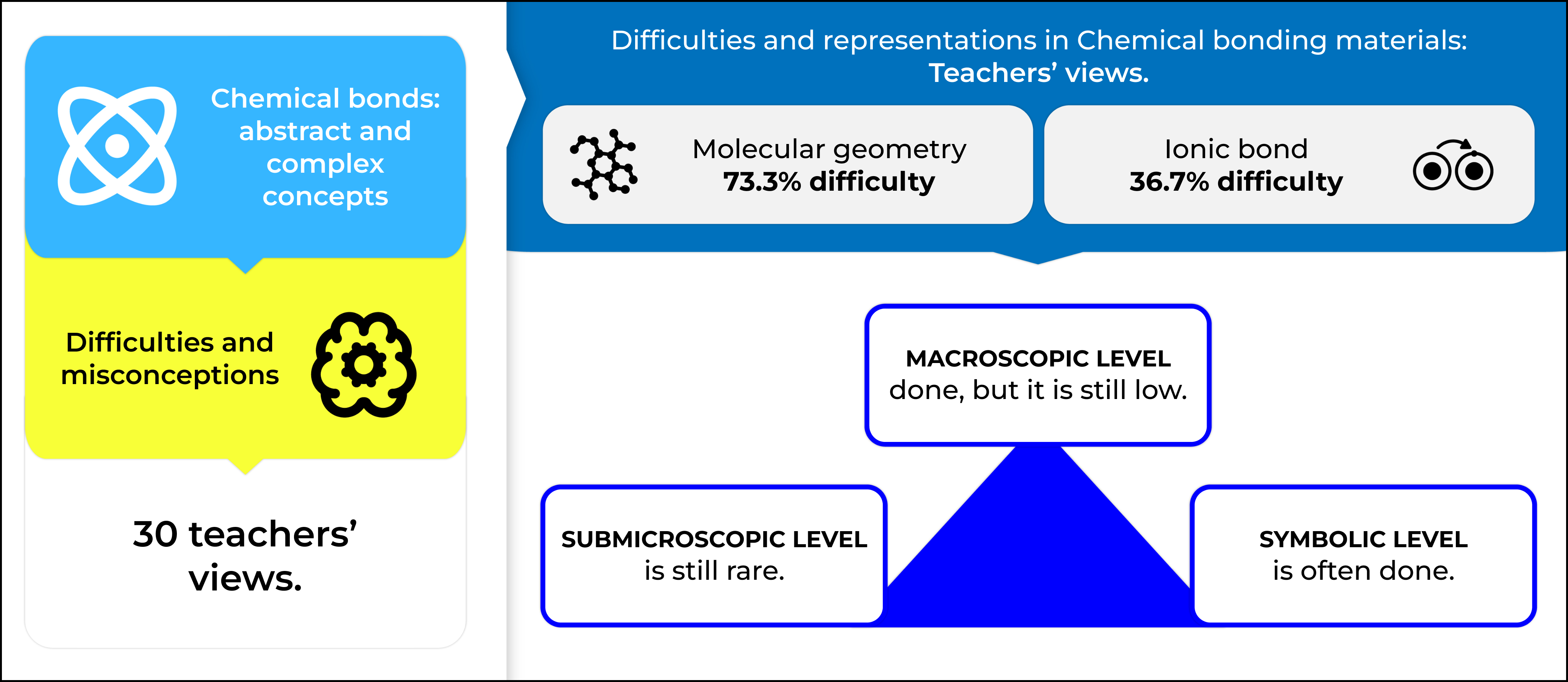
Chemical bonding involves three levels of representation, namely macroscopic, submicroscopic, and symbolic, which are often difficult for students to understand due to their abstract and complex concepts. In this case, teachers play an important role as facilitators. However, teachers still experience various challenges in applying a multiple representation approach. This study aims to identify and analyze the difficulties in multi-representation-based chemical bonds based on the views of several chemistry teachers. A total of 14 open and closed question items via Google Forms were distributed online. Based on a survey of several chemistry teachers, the most difficult sub-material in chemical bonds is molecular geometry, while the easiest is ionic bonds. Chemistry teachers participating in this study tend to focus more on symbolic, macroscopic, and submicroscopic representations in teaching chemical bonds.
References
Ahmar, D. S.; Azzajjad, M. F.; Syahrir, Muh. Students’ Representation Ability in Chemistry. Journal of Applied Science, Engineering, Technology, and Education. 2020, 2 (2), 181–187. https://doi.org/10.35877/454RI.asci22124
Danin, V. J.; Kamaludin, A. Development of Google Sites Based Learning Media on Chemical Bonds with Multilevel Chemical Representation. Jurnal Penelitian Pendidikan IPA. 2023, 9 (9), 6727–6733. https://doi.org/10.29303/jppipa.v9i9.1552
Dawati, F. M.; Yamtinah, S.; Rahardjo, S. B.; Ashadi, A.; Indriyanti, N. Y. Analysis of Students’ Difficulties in Chemical Bonding Based on Computerized Two-Tier Multiple Choice (CTTMC) Test. J. Phys. Conf. Ser. 2019, 1157, 042017. https://doi.org/10.1088/1742-6596/1157/4/042017
Effendy. Molekul, Struktur, Dan Sifat-Sifatnya; Indonesian Academic Publishing: Malang, 2017.
Effendy. Perspektif Baru Ikatan Ionik Edisi 4; Indonesian Academic Publishing: Malang, 2020.
Halim, N. D. A.; Ali, M. B.; Yahaya, N.; Said, M. N. H. M. Mental Model in Learning Chemical Bonding: A Preliminary Study. Procedia Soc Behav Sci. 2013, 97, 224–228. https://doi.org/10.1016/j.sbspro.2013.10.226
Hasanah, D.; W.; Mulyani, S.; Widhiyanti, T. Multiple Representations Analysis of Chemical Bonding Concepts in General Chemistry Books. KnE Social Sciences. 2024, 248–257. https://doi.org/10.18502/kss.v9i8.15554
Head, M. L.; Yoder, K.; Genton, E.; Sumperl, J. A Quantitative Method to Determine Preservice Chemistry Teachers’ Perceptions of Chemical Representations. Chemistry Education Research and Practice. 2017, 18 (4), 825–840. https://doi.org/10.1039/C7RP00109F
Li, W. S. S.; Arshad, M. Y. Application of Multiple Representation Levels in Redox Reactions among Tenth Grade Chemistry Teachers. Journal of Turkish Science Education. 2014, 11 (3), 35–52.
Meltafina, M.; Wiji, W.; Mulyani, S. Misconceptions and Threshold Concepts in Chemical Bonding. J. Phys. Conf. Ser. 2019, 1157, 0420301–0420305. https://doi.org/10.1088/1742-6596/1157/4/042030
Mindayula, E.; Sutrisno, H. Multiple Representation: The Teacher’s Perception in Chemistry Learning. J. Phys. Conf. Ser. 2021, 1806 (1), 0121941. https://doi.org/10.1088/1742-6596/1806/1/012194
Nugraha, M.; Supriatna, A.; Fatimah, S. S. Analysis of Student Difficulties Based on Respondents Ability Test on the Topic of Geometry Molecules. J. Phys. Conf. Ser. 2019, 1280 (3), 032012. https://doi.org/10.1088/1742-6596/1280/3/032012
Rahmawati, Y.; Dianhar, H.; Arifin, F. Analysing Students’ Spatial Abilities in Chemistry Learning Using 3D Virtual Representation. Educ. Sci. (Basel). 2021, 11 (4), 185. https://doi.org/10.3390/educsci11040185
Sari, N.; Sidauruk, S.; Meiliawati, R.; Sari, A. R. P. The Difficulties of X Grade High School Students in Palangka Raya City Academic Year of 2018/2019 in Understanding Chemical Bond Concept Using Two-Tier Multiple Choice. GAMAPROIONUKLEUS. 2020, 1 (2), 135–148. https://doi.org/10.37304/jpmipa.v1i2.3686
Setiawan, N. C. E.; Ilahi, P. R. Identification of Misconceptions in Chemical Bonding Materials Using Three Tier Diagnostic Test. Journal of Natural Science and Integration. 2022, 5 (1), 77. https://doi.org/10.24014/jnsi.v5i1.16860
Siregar, E. A.; Wiyarsi, A. Students’ Mental Models For Molecule Shapes Concepts: A Multiple-Repesentation Perspective. Jurnal Kependidikan Penelitian Inovasi Pembelajaran. 2023, 7 (1), 58–67. https://doi.org/10.21831/jk.v7i1.59992
Widarti, H. R. Multiple Representations in Chemistry Learning: A Study on Teachers’ Literacy; 2021; 0200421–0200429. https://doi.org/10.1063/5.0043360
Widarti, H. R. Multiple Representation-Based Cognitive Dissonance: A Strategy to Reduce Misconception in Chemistry Learning. In The 5th International Conference on Mathematics and Science Education (ICoMSE). 2023, 2021, 030003. https://doi.org/10.1063/5.0112157
Widarti, H. R.; Wiyarsi, A.; Yamtinah, S.; Siddiq, A. S.; Sari, M. E. F.; Fauziah, P. N.; Rokhim, D. A. Analysis of Content Development in Chemical Materials Related to Ethnoscience: A Review. Journal of Education and Learning. 2025, 19 (1), 422–430. https://doi.org/10.11591/edulearn.v19i1.21210
Widarti, H. R.; Safitri, A. F.; Sukarianingsih, D. Identifikasi Pemahaman Konsep Ikatan Kimia. Jurnal Pembelajaran Kimia. 2018, 3 (1), 41–50. https://doi.org/10.17977/um026v3i12018p041
Yakina, Y.; Kurniati, T.; Fadhilah, R. Analisis Kesulitan Belajar Siswa Pada Mata Pelajaran Kimia Kelas X Di SMA Negeri 1 Sungai Ambawang. AR-RAZI Jurnal Ilmiah. 2017, 5 (2), 287–297. https://doi.org/10.29406/arz.v5i2.641

This work is licensed under a Creative Commons Attribution 4.0 International License.
Copyright (c) 2025 Eclética Química