
Keywords
critical thinking
fake news
media literacy
science
How to Cite




Abstract
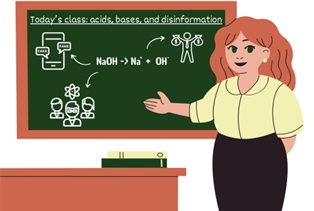
This paper is rooted in the premise that addressing scientific disinformation and misinformation about acid-base theories requires a multidisciplinary approach, approximating acid-base knowledge with content typically not addressed in chemistry classes. Stemming from this principle, this paper analyzes how peer-reviewed publications for chemistry teaching approach the representation of acid-base theories in the context of informational disorders (disinformation and misinformation) through a literature review and textual analysis. The papers analyzed address cases of informational disorders through a disciplinary lens, with a pronounced emphasis on resorting to acid-base contents to debunk erroneous messages, even though the contexts explored reference socioscientific issues. As a response, this paper broadens the conservation, by proposing other contents that could convey the nature of science as well, the functioning of traditional and modern media, and values and ideologies. By doing so, this paper provides more elements for critical and broader readings of acid-base theories in informational disorders, elevating chemistry teaching to better address contemporary challenges arising from the interplay between science and media.
References
Algarra, R. V. M.; Zamora, L. L.; Fos, G. M. A.; López, P. A. A. Magnetized Water: Science or Fraud? Journal of Chemical Education. 2008, 85 (10), 1416–1418. https://doi.org/10.1021/ed085p1416
Allchin, D. What Counts as Science. The American Biology Teacher. 2012, 74 (4), 291–294. https://doi.org/10.1525/abt.2012.74.4.17
Allchin, D. From Test Tubes to Youtube: Nature of Science in Socioscientific Issues and History. In Emerging Computacional Media and Science Education. 2015.
Allchin, D. Who Speaks for Science? Science & Education. 2021, 31, 1475–1492. https://doi.org/10.1007/s11191-021-00257-4
Arroio, A. Is Media Literacy an Urgent Issue in Education for All? Problems of Education in the 21st Century. 2017, 75 (5), 416–418. https://doi.org/10.33225/pec/17.75.416
Arroio, A. The value of education in the context of Covid-19 pandemic. Problems of Education in the 21st Century. 2020, 78 (3), 309–313. https://doi.org/10.33225/pec/20.78.309
Aromataris, E.; Pearson, A. The Systematic Review: An Overview. AJN, American Journal of Nursing. 2014, 114 (3), 53–58. https://doi.org/10.1097/01.NAJ.0000444496.24228.2c
Belova, N.; Chang Rundgren, S.-N.; Eilks, I. Advertising and Science Education: A Multi-Perspective Review of the Literature. Studies in Science Education. 2015, 51 (2), 169–200. https://doi.org/10.1080/03057267.2015.1049444
Belova, N.; Eilks, I. Learning with and about Advertising in Chemistry Education with a Lesson Plan on Natural Cosmetics – a Case Study. Chemistry Education Research and Practice. 2015, 16 (3), 578–588. https://doi.org/10.1039/c5rp00035a
Bimber, B.; Zúñiga, G. H. The Unedited Public Sphere. New Media & Society. 2020, 22 (4), 700–715. https://doi.org/10.1177/1461444819893980
Boulware, L. Ebony.; Cooper, L. A.; Ratner, L. E.; LaVeist, T. A.; Powe, N. R. Race and Trust in the Health Care System. Public Health Reports. 2003, 118 (4), 358–365. https://doi.org/10.1016/s0033-3549(04)50262-5
Campos, R. C.; Silva, R. C. Funções Da Química Inorgânica ...Funcionam? Química nova na Escola. 1999, (9), 18–22.
Cardoso, D.; Gurgel, I. Por Uma Educação Científica Que Problematize a Mídia. Linhas Críticas. 2019, 25, 74–93. https://doi.org/10.26512/lc.v25.2019.19850
Covitt, B. A.; Anderson, C. W. Untangling Trustworthiness and Uncertainty in Science. Science & Education. 2022, 31, 1155–1180. https://doi.org/10.1007/s11191-022-00322-6
Cunha, M. B. A Química “Mal Dita” em Fake Science. Revista de Ensino de Ciências e Matemática. 2021, 12 (6), 1–25. https://doi.org/10.26843/rencima.v12n6a09
Das, R.; Ahmed, W. Rethinking Fake News: Disinformation and Ideology during the Time of COVID-19 Global Pandemic. IIM Kozhikode Society & Management Review. 2021, 11 (1), 146–159. https://doi.org/10.1177/22779752211027382
Drechsler, M.; Van Driel, J. Experienced Teachers’ Pedagogical Content Knowledge of Teaching Acid–Base Chemistry. Research in Science Education. 2007, 38 (5), 611–631. https://doi.org/10.1007/s11165-007-9066-5
Dodds, R. E.; Tseëlon, E.; Weitkamp, E. L. C. Making Sense of Scientific Claims in Advertising. A Study of Scientifically Aware Consumers. Public Understanding of Science. 2008, 17 (2), 211–230. https://doi.org/10.1177/0963662506065559
Feinstein, N. W.; Waddington, D. I. Individual Truth Judgments or Purposeful, Collective Sensemaking? Rethinking Science Education’s Response to the Post-Truth Era. Educational Psychologist. 2020, 55 (3), 155–166. https://doi.org/10.1080/00461520.2020.1780130
Furió-Más, C.; Calatayud, M. L.; Guisasola, J.; Furió-Gomez, C. How Are the Concepts and Theories of Acid–Base Reactions Presented? Chemistry in Textbooks and as Presented by Teachers. International Journal of Science Education. 2005, 27 (11), 1337–1358. https://doi.org/10.1080/09500690500102896
Funk, S.; Kelnner, D.; Share, J. Critical Media Literacy as Transformative Pedagogy. In Journalism and Ethics: Breakthroughs in Research and Practice; IGI Global, 2019; pp 318–348.
Ghinea, G.; Cardoso, S. G.; Caparelli, M. C. M. Case Study: Fake News and Threats to Brazilians’ Health. In: Fake news in an era of social media: tracking viral contagion. Ibrahim, Y., Safieddine, F., Eds.; Rowman & Littlefield, 2020; pp 59–72.
Hauge, K. H. A Tool for Reflecting on Questionable Numbers in Society. Studies in Philosophy and Education. 2022, 41 (5), 511–528. https://doi.org/10.1007/s11217-022-09836-6
Höttecke, D.; Allchin, D. Reconceptualizing Nature of Science Education in the Age of Social Media. Science Education. 2020, 104 (4), 641–666. https://doi.org/10.1002/sce.21575
Kahan, D. M.; Peters, E.; Wittlin, M.; Slovic, P.; Ouellette, L. L.; Braman, D.; Mandel, G. The Polarizing Impact of Science Literacy and Numeracy on Perceived Climate Change Risks. Nature Climate Change. 2012, 2 (10), 732–735. https://doi.org/10.1038/nclimate1547
Kellner, D.; Share, J. The Critical Media Literacy Guide: Engaging Media and Transforming Education; Brill Sense, 2019.
Kovach, B.; Rosenstiel, T. Blur: How to Know What’s True in the Age of Information Overload; Bloomsbury, 2011.
Lima, C.; Moradillo, E. F. Ácidos e Bases nos Livros Didáticos: ainda Duas das Quatro Funções da Química Inorgânica? Química Nova na Escola. 2019, 41 (3), 242–247. https://doi.org/10.21577/0104-8899.20160167
Locatelli, S. W. Reflecting upon Fake News in Today’s Post-Truth Era. Problems of Education in the 21st Century. 2021, 79 (4), 513–515. https://doi.org/10.33225/pec/21.79.513
Lu, J.; Zhang, M.; Zheng, Y.; Li, Q. Communication of Uncertainty about Preliminary Evidence and the Spread of Its Inferred Misinformation during the COVID-19 Pandemic—a Weibo Case Study. International Journal of Environmental Research and Public Health. 2021, 18 (22), 1–17. https://doi.org/10.3390/ijerph182211933
Miller, J.; Rost, L.; Bryant, C.; Embry, R.; Iqbal, S.; Lannoye-Hall, C.; Oslon, M. Media Literacy in the Age of Covid and Climate Change. The Science Teacher. 2021, 88 (6), 20–30.
Oreskes, N. Why Trust Science? Princeton University Press, 2019.
Oreskes, N.; Conway, E. M. Merchants of Doubt: How a Handful of Scientists Obscured the Truth on Issues from Tobacco Smoke to Global Warming; Bloomsbury, 2010.
Osborne, J.; Pimentel, D. Science Education in an Age of Misinformation. Science Education. 2023, 107 (3), 553–571. https://doi.org/10.1002/sce.21790
Oxford Languages. Oxford Word of the Year 2016; Oup.com, 2016. https://languages.oup.com/word-of-the-year/2016/ (accessed 2024-12-26).
Pivaro, G. F.; Girotto Júnior, G. O Ataque Organizado à Ciência como Forma de Manipulação: do Aquecimento Global ao Coronavírus. Caderno Brasileiro de Ensino de Física. 2020, 37 (3), 1074–1098. https://doi.org/10.5007/2175-7941.2020v37n3p1074
Reid, G.; Norris, S. P. Scientific Media Education in the Classroom and Beyond: A Research Agenda for the Next Decade. Cultural Studies of Science Education. 2015, 11 (1), 147–166. https://doi.org/10.1007/s11422-015-9709-1
Ribeiro, F. V.; de Oliveira Amorim, A. P.; Silva Lopes, C. Discutindo Fake News sobre Química Durante a Pandemia da COVID-19. Revista Thema. 2022, 21 (2), 387–401. https://doi.org/10.15536/thema.v21.2022.387-401.2176
Rosenberg, J. M.; Kubsch, M.; Wagenmakers, E.-J.; Dogucu, M. Making Sense of Uncertainty in the Science Classroom. Science & Education. 2022, 31 (5), 1239–1262. https://doi.org/10.1007/s11191-022-00341-3
Santos, W. L. P. dos. Educação Científica Na Perspectiva de Letramento como Prática Social: Funções, Princípios e Desafios. Revista Brasileira de Educação. 2007, 12 (36), 474–492. https://doi.org/10.1590/s1413-24782007000300007
Schulz, A.; Roessler, P. The Spiral of Silence and the Internet: Selection of Online Content and the Perception of the Public Opinion Climate in Computer-Mediated Communication Environments. International Journal of Public Opinion Research. 2012, 24 (3), 346–367. https://doi.org/10.1093/ijpor/eds022
Shaheen, N.; Shaheen, A.; Ramadan, A.; Hefnawy, M. T.; Ramadan, A.; Ibrahim, I. A.; Hassanein, M. E.; Ashour, M. E.; Flouty, O. Appraising Systematic Reviews: A Comprehensive Guide to Ensuring Validity and Reliability. Frontiers in Research Metrics and Analytics. 2023, 8 (8), 1–9. https://doi.org/10.3389/frma.2023.1268045
Siqueira, F.; Arroio, A. A Strategy for Addressing Fake News and Denialism in Elementary and Secondary Schools. Annales Universitatis Paedagogicae Cracoviensis. 2022, 12, 120–132. https://doi.org/10.24917/20837267.12.10
Silva, M. B.; Sasseron, L. H. Alfabetização Científica e Domínios do Conhecimento científico: Proposições para uma Perspectiva Formativa Comprometida com a Transformação Social. Ensaio Pesquisa em Educação em Ciências, 2021, 23 (e34674), 1–20. https://doi.org/10.1590/1983-21172021230129
Silva, E. M. dos S.; Arroio, A. Science Literacy in the Age of Disinformation: Building Bridges to Address the Complexity of the Challenge. In Media and information literacy for the public good: UNESCO MILID Yearbook 2023.; Jaakkola, M., Tomás, D.-B., Bosire Onyancha, O., Eds.; Corporación Universitaria Minuto de Dios - UNIMINUTO, 2023; pp 81–100.
Silva, E. M. dos S.; Arroio, A. Letramento Midiático na Formação de Licenciandos em Ciências da Universidade de São Paulo: o que Revelam as Ementas? Ciência & Educação (Bauru). 2025, 31 (e25015), 1-15. https://doi.org/10.1590/1516-731320250015
Souza, C. R. de; Silva, F. C. Discutindo o Contexto das Definições de Ácido e Base. Química Nova na Escola. 2018, 40 (1), 14–18. https://doi.org/10.21577/0104-8899.20160099
Souza, L. K. Pesquisa com Análise Qualitativa de Dados: Conhecendo a Análise Temática. Arquivos Brasileiros de Psicologia. 2019, 71 (2), 51–67. https://doi.org/10.36482/1809-5267.ARBP2019v71i2p.51-67
Stroppa, T. Primeiro de Abril, a Descoberta do “Boimate” e o Combate às Fake News. CartaCapital, 2018. https://www.cartacapital.com.br/blogs/intervozes/primeiro-de-abril-a-descoberta-do-201cboimate201d-e-o-combate-as-fake-news/ (accessed 2024-12-11).
Swire-Thompson, B.; Lazer, D. Reducing Health Misinformation in Science: A Call to Arms. The ANNALS of the American Academy of Political and Social Science. 2022, 700 (1), 124–135. https://doi.org/10.1177/00027162221087686
Toby, S. Chemistry in the Public Domain: A Plethora of Misinformation - or, Don’t Believe Everything You Read in the Newspapers! Journal of Chemical Education. 1997, 74 (11), 1285. https://doi.org/10.1021/ed074p1285
UNESCO. Jornalismo, “Fake News” E Desinformação. Manual Para Educação Em Jornalismo; UNESCO, 2019.
Vosoughi, S.; Roy, D.; Aral, S. The Spread of True and False News Online. Science. 2018, 359 (6380), 1146–1151. https://doi.org/10.1126/science.aap9559
Valladares, L. Post-Truth and Education. Science & Education. 2022, 31, 1311–1337. https://doi.org/10.1007/s11191-021-00293-0
Valladares, L. Scientific Literacy and Social Transformation. Science & Education. 2021, 30 (3), 557–587. https://doi.org/10.1007/s11191-021-00205-2
Wu, T. Blind Spot: The Attention Economy and the Law. Antitrust L. J. 2019, 82, 771.

This work is licensed under a Creative Commons Attribution 4.0 International License.
Copyright (c) 2025 Eclética Química