
Palavras-chave
conceitos químicos
aprendizado de química
estratégias de ensino
projeto de currículo
Como Citar




Resumo
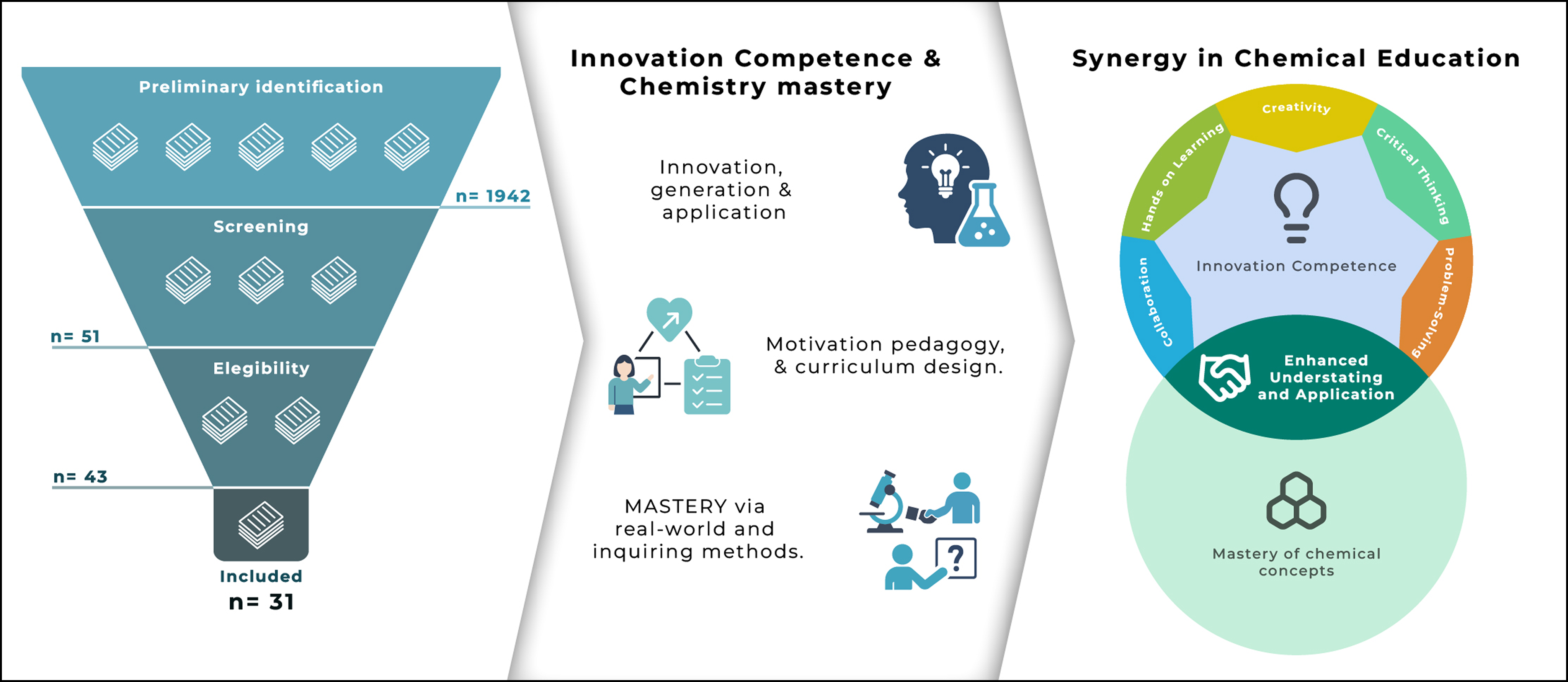
Atualmente, a competência em inovação é uma habilidade essencial que permite aos indivíduos gerar e aplicar ideias inovadoras. Sua influência no domínio de conceitos químicos pelos alunos e os fatores que moldam essa relação ainda são pouco explorados. Esta revisão de escopo analisa 31 estudos para abordar três questões de pesquisa: (1) Como a competência em inovação influencia o domínio de conceitos químicos pelos alunos? (2) Quais fatores moldam essa relação? (3) Que estratégias os educadores podem implementar para promover a competência em inovação e o domínio de conceitos químicos? Os resultados revelam uma correlação positiva entre a competência em inovação e o domínio químico, influenciada pela motivação, pelas estratégias de ensino e pelo projeto curricular. As estratégias práticas incluem aprendizado baseado em problemas, projetos colaborativos e atividades práticas. Embora essas percepções forneçam uma orientação valiosa, são necessárias mais pesquisas para entender completamente a interação entre a competência em inovação e o aprendizado químico. Este estudo oferece recomendações práticas para o aprimoramento das práticas de ensino e o avanço de pesquisas futuras no ensino de química.
Referências
Anim-Eduful, B.; Adu-Gyamfi, K. Nature of Senior High School Chemistry Students’ Alternative Conceptions in Organic Qualitative Analysis. Aquademia. 2023, 7 (2), ep23007. https://doi.org/10.29333/aquademia/13711
Anwar, S.; Menekse, M.; Guzey, S. S.; Bryan, L. A. The Effectiveness of an Integrated STEM Curriculum Unit on Middle School Students’ Life Science Learning. J. Res. Sci. Teach. 2022, 59 (7), 1204–1234. https://doi.org/10.1002/tea.21756
Arksey, H.; O’Malley, L. Scoping Studies: Towards a Methodological Framework. Int. J. Soc. Res. Methodol. 2005, 8 (1), 19–32. https://doi.org/https://doi.org/10.1080/1364557032000119616
Atamanyuk, S.; Semenikhina, O.; Shyshenko, I. Theoretical fundamentals of innovation of higher education in Ukraine. Pedagogy and Education Management Review (PEMR). 2021, 2 (4), 30–36. https://doi.org/10.36690/2733-2039-2021-2-30
Brändle, M.; Sotiriadou, C.; Zinn, B. Self-Assessments, Attitudes, and Motivational Orientations towards the Use of Digital Media in Teaching a Comparison between Student Teachers of Different Subject Clusters. Heliyon. 2023, 9 (9), e19516. https://doi.org/10.1016/j.heliyon.2023.e19516
Brunnert, R.; Tausch, M. W. Green Chemistry in STEM Education: Light for Basic Concepts. World J. Chem. Educ. 2023, 11 (3), 65–73. https://doi.org/10.12691/wjce-11-3-8
Cai, Y.; Tang, R. School Support for Teacher Innovation: The Role of Basic Psychological Need Satisfaction. Think. Ski. Creat. 2022, 45, 101096. https://doi.org/10.1016/j.tsc.2022.101096
Charosky, G.; Hassi, L.; Papageorgiou, K.; Bragós, R. Developing Innovation Competences in Engineering Students: A Comparison of Two Approaches. Eur. J. Eng. Educ. 2022, 47 (2), 353–372. https://doi.org/10.1080/03043797.2021.1968347
Chiu, W. K. Pedagogy of Emerging Technologies in Chemical Education during the Era of Digitalization and Artificial Intelligence: A Systematic Review. Educ. Sci. 2021, 11 (11), 709. https://doi.org/10.3390/educsci11110709
Clark, R. M.; Stabryla, L. M.; Gilbertson, L. M. Use of Active Learning and the Design Thinking Process to Drive Creative Sustainable Engineering Design Solutions. 125th ASEE Annual Conference and Exposition. American Society for Engineering Education. 2018, 21181.
Czok, V.; Krug, M.; Müller, S.; Huwer, J.; Weitzel, H. Learning Effects of Augmented Reality and Game-Based Learning for Science Teaching in Higher Education in the Context of Education for Sustainable Development. Sustain. 2023, 15 (21), 15313. https://doi.org/10.3390/su152115313
Droescher, M. Chemistry: The Driving Force for Emerging Technologies. Chemistry International. 2018, 40 (4), 14–17. https://doi.org/10.1515/ci-2018-0405
Dunnigan, K. A.; Dunford, A.; Bringardner, J. From Cornerstone to Capstone: Students’ Design Thinking and Problem Solving. 2020 ASEE Virtual Annual Conference, ASEE 2020, June 22-26, 30836.
Ellah, B. O.; Achor, E. E.; Enemarie, V. Problem-Solving Skills as Correlates of Attention Span and Working Memory of Low Ability Level Students in Senior Secondary Schools. J. Educ. e-Learning Res. 2019, 6 (3), 135–141. https://doi.org/10.20448/journal.509.2019.63.135.141
Fredagsvik, M. S. The Challenge of Supporting Creativity in Problem-Solving Projects in Science: A Study of Teachers’ Conversational Practices with Students. Res. Sci. Technol. Educ. 2023, 41 (1), 289–305. https://doi.org/10.1080/02635143.2021.1898359
Gomollón-Bel, F. Ten Chemical Innovations That Will Change Our World. Chem. Int. 2020, 42 (4), 3–9. https://doi.org/10.1515/ci-2020-0402
Handayani, D.; Winarni, E. W.; Sundaryono, A.; Firdaus, M. L. Implementation of Project-Based Learning Model with Edmodo Application in the Capita Selecta Chemistry Course. Int. J. Recent Educ. Res. 2021, 2 (2), 184–195. https://doi.org/10.46245/ijorer.v2i2.90
He, P.; Krajcik, J.; Schneider, B. Transforming Standards into Classrooms for Knowledge-in-Use: An Effective and Coherent Project-Based Learning System. Discip. Interdiscip. Sci. Educ. Res. 2023, 5, 22. https://doi.org/10.1186/s43031-023-00088-z
Hernández-Torrano, D.; Ibrayeva, L. Creativity and Education: A Bibliometric Mapping of the Research Literature (1975–2019). Think. Ski. Creat. 2020, 35, 100625. https://doi.org/10.1016/j.tsc.2019.100625
Hero, L. M.; Pitkäjärvi, M.; Matinheikki-Kokko, K. Validating an Individual Innovation Competence Assessment Tool for University–Industry Collaboration. Ind. High. Educ. 2021, 35 (4), 485–496. https://doi.org/10.1177/09504222211017447
Jaleniauskiene, E.; Kasperiuniene, J. Infographics in Higher Education: A Scoping Review. E-Learning Digit. Media. 2022, 20 (2), 191–206. https://doi.org/10.1177/20427530221107774
Jenniffer, A. G.; Jenny, J. C.; Balaji, V. P.; Yadav, R. Chemistry Innovations and Ideas from the Classroom to the Real World: The Students’ Perspective on Becoming a Chemistry Entrepreneur. J. Chem. Educ. 2022, 99 (4), 1556–1562. https://doi.org/10.1021/acs.jchemed.1c00133
Kalkbrenner, M.; Horton-Parker, R. Applying John Dewey’s Theory of Education to Infuse Experiential Learning in an Introduction to Human Services Course. J. Hum. Serv. 2016, 36 (1), 65–68.
Kanapathy, S.; Lee, K. E.; Sivapalan, S.; Mokhtar, M.; Syed Zakaria, S. Z.; Mohd Zahidi, A. Sustainable Development Concept in the Chemistry Curriculum: An Exploration of Foundation Students’ Perspective. Int. J. Sustain. High. Educ. 2019, 20 (1), 2–22. https://doi.org/10.1108/IJSHE-04-2018-0069
Keinänen, M. M.; Kairisto-Mertanen, L. Researching Learning Environments and Students’ Innovation Competences. Educ. Train. 2019, 61 (1), 17–30. https://doi.org/10.1108/ET-03-2018-0064
Kirchhoff, T.; Randler, C.; Großmann, N. Experimenting at an Outreach Science Lab versus at School—Differences in Students’ Basic Need Satisfaction, Intrinsic Motivation, and Flow Experience. J. Res. Sci. Teach. 2023, 60 (10), 2255–2293. https://doi.org/10.1002/tea.21859
Krab-Hüsken, L. E.; Pei, L.; de Vries, P. G.; Lindhoud, S.; Paulusse, J. M. J.; Jonkheijm, P.; Wong, A. S. Y. Conceptual Modeling Enables Systems Thinking in Sustainable Chemistry and Chemical Engineering. J. Chem. Educ. 2023, 100 (12), 4577–4584. https://doi.org/10.1021/acs.jchemed.3c00337
Krstikj, A.; Sosa Godina, J.; García Bañuelos, L.; González Peña, O. I.; Quintero Milián, H. N.; Urbina Coronado, P. D.; Vanoye García, A. Y. Analysis of Competency Assessment of Educational Innovation in Upper Secondary School and Higher Education: A Mapping Review. Sustain. 2022, 14 (13). https://doi.org/10.3390/su14138089
Laliyo, L. A. R.; Utina, R.; Husain, R.; Umar, M. K.; Katili, M. R.; Panigoro, C. Evaluating Students’ Ability in Constructing Scientific Explanations on Chemical Phenomena. Eurasia J. Math. Sci. Technol. Educ. 2023, 19 (9), em2328. https://doi.org/10.29333/ejmste/13524
Lenihan, S.; Foley, R.; Carey, W. A.; Duffy, N. B. Developing Engineering Competencies in Industry for Chemical Engineering Undergraduates through the Integration of Professional Work Placement and Engineering Research Project. Educ. Chem. Eng. 2020, 32, 82–94. https://doi.org/10.1016/j.ece.2020.05.002
Lewis, Y. W. S. E. Analytical Chemistry Students’ Explanatory Statements in the Context of Their Corresponding Lecture. Chem. Educ. Res. Pract. 2020, 21 (4), 1183–1198. https://doi.org/10.1039/d0rp00063a
Liliasari, S.; Amsad, L. N.; Wahyudi, A. Innovative Chemistry Education: An Alternative Course Models in the Disruption Era. J. Phys. Conf. Ser. 2021, 1731, 012023. https://doi.org/10.1088/1742-6596/1731/1/012023
Luo, J. Clothing Color Innovative Fashion Design Thinking Integrating Color Matching Quantum Search Model (CMQSM). Pap. Asia. 2018, 1, 86–90.
Mahaffy, P. G.; Krief, A.; Hopf, H.; Mehta, G.; Matlin, S. A. Reorienting Chemistry Education through Systems Thinking. Nat. Rev. Chem. 2018, 2 (4), 1–3. https://doi.org/10.1038/s41570-018-0126
Margallo, M.; Dominguez-Ramos, R.; Aldaco, A. Incorporating Life Cycle Assessment and Ecodesign Tools for Green Chemical Engineering: A Case Study of Competences and Learning Outcomes Assessment. Educ. Chem. Eng. 2019, 26, 89–96. https://doi.org/10.1016/j.ece.2018.08.002
Muna, G. W. Stimulating Students’ Learning in Analytical Chemistry through an Environmental-Based CURE Project. J. Chem. Educ. 2021, 98 (4), 1221–1226. https://doi.org/10.1021/acs.jchemed.0c01326
Nagpal, N.; Rahmawati, A. M. Y. Integrating Augmented Reality (AR) and Virtual Reality (VR) in Transformation of Teaching and Learning Pedagogy in Education 4.0. In Architecture and Technological Advancements of Education 4.0. 2023; pp 199–228. https://doi.org/10.4018/978-1-6684-9285-7.ch009
Nasir, N. A.; Kiong, T. T.; Sai’en, S.; Qi, W.; Azid, N.; Singh, C. K. S.; Ichwanto, M. A.; Juhari, M. I. The Effects of Thinking Styles and Inventive Problem-Solving on the Problem-Solving Skills for Design and Technology Students. J. Tech. Educ. Train. 2023, 15 (4), 11–22. https://doi.org/10.30880/jtet.2023.15.04.002
Obada, D. O.; Bako, R. B.; Ahmed, A. S.; Anafi, F. O.; Eberemu, A. O.; Dodoo-Arhin, D.; Oyedeji, A. N.; Salami, K. A.; Samuel, B. O.; Samuel, E. T.; Obada, I. B. Teaching Bioengineering Using a Blended Online Teaching and Learning Strategy: A New Pedagogy for Adapting Classrooms in Developing Countries. Educ. Inf. Technol. 2023, 28 (4), 4649–4672. https://doi.org/10.1007/s10639-022-11330-y
Obolewicz, J.; Baryłka, A.; Szota, M.; Borkowski, S. Improving Activities in the Processes of Ensuring the Quality of Education in Higher Education Schools and Scientific Institutes. J. Achiev. Mater. Manuf. Eng. 2023, 120 (2), 92–104. https://doi.org/10.5604/01.3001.0054.0110
OECD. PISA 2021 Creative Thinking Framework. Oecd. 2019, 53 (9), 1689–1699.
Ojeda, M. D.; Queiruga-Dios, M. Á.; Velasco-Pérez, N.; López-Iñesta, E.; Vázquez-Dorrío, J. B. Inquiry through Industrial Chemistry in Compulsory Secondary Education for the Achievement of the Development of the 21st Century Skills. Educ. Sci. 2021, 11 (9), 475. https://doi.org/10.3390/educsci11090475
Ong, E. T.; Singh, C. K. S.; Wahid, R.; Saad, M. I. M. Uncovering Pedagogical Gaps in a Chemistry Classroom: Implications for Teaching and Learning. Int. J. Eval. Res. Educ. 2023, 12 (2), 979–990. https://doi.org/10.11591/ijere.v12i2.23042
Ovbiagbonhia, A. R. Learning to Innovate: How to Foster Innovation Competence in Students of Built Environment at Universities of Applied Sciences, Wageningen University and Research, 2021.
Ovbiagbonhia, A. R.; Kollöffel, B.; Brok, P. den. Educating for Innovation: Students’ Perceptions of the Learning Environment and of Their Own Innovation Competence. Learn. Environ. Res. 2019, 22 (3), 387–407. https://doi.org/10.1007/s10984-019-09280-3
Peeters, H.; Habig, S.; Fechner, S. Does Augmented Reality Help to Understand Chemical Phenomena during Hands-On Experiments?–Implications for Cognitive Load and Learning. Multimodal Technol. Interact. 2023, 7 (2), 9. https://doi.org/10.3390/mti7020009
Peters, M.; Godfrey, C. M.; Khalil, H.; McInerney, P.; Parker, D.; Soares, C. B. Guidance for Conducting Systematic Scoping Reviews. Int. J. Evid. Based. Healthc. 2015, 13 (3), 141–146. https://doi.org/10.1097/XEB.0000000000000050
Ramírez-Montoya, M. S.; Loaiza-Aguirre, M. I.; Zúñiga-Ojeda, A.; Portuguez-Castro, M. Characterization of the Teaching Profile within the Framework of Education 4.0. Futur. Internet. 2021, 13 (4), 1–17. https://doi.org/10.3390/fi13040091
Rampersad, G. Robot Will Take Your Job: Innovation for an Era of Artificial Intelligence. J. Bus. Res. 2020, 116 (January), 68–74. https://doi.org/10.1016/j.jbusres.2020.05.019
Rusmansyah, R.; Yuanita, L.; Ibrahim, M.; Isnawati; Prahani, B. K. Innovative Chemistry Learning Model: Improving the Critical Thinking Skill and Self-Efficacy of Pre-Service Chemistry Teachers. J. Technol. Sci. Educ. 2019, 9 (1), 59–76. https://doi.org/10.3926/jotse.555
Salleh, M. F. M.; Rauf, R. A. A.; Saat, R. M.; Ismail, M. H. Learners’ Issues in the Preparation and Qualitative Analysis of Salts Topics in Chemistry: Teachers’ Perspectives. Eur. J. Sci. Math. Educ. 2023, 11 (3), 392–409. https://doi.org/10.30935/scimath/12789
Shidiq, A. S.; Permanasari, A.; Hernani; Hendayana, S. Contemporary Hybrid Laboratory Pedagogy: Construction of a Simple Spectrophotometer with STEM Project-Based Learning to Introduce Systems Thinking Skills. Asia Pacific J. Educ. Educ. 2022, 37 (2), 107–146. https://doi.org/10.21315/apjee2022.37.2.6
Sinaga, M. S.; Situmorang, M. S.; Hutabarat, W. H. Implementation of Innovative Learning Material to Improve Students Competence on Chemistry. Indian J. Pharm. Educ. Res. 2019, 53 (1), 28–41. https://doi.org/10.5530/ijper.53.1.5
Solodikhina, A. A.; Solodikhina, M. V. Development of Innovative Competence Model and Its Testing in the Course “Techno-Startup.” Integr. Educ. 2023, 27 (2), 289–308. https://doi.org/10.15507/1991-9468.111.027.202302.289-308
Spaan, W.; Oostdam, R.; Schuitema, J.; Pijls, M. Thinking-Back-and-Forth in Practical Work Experienced by Students: Identifying Evidence-Informed Characteristics of Good Practices in Secondary Education. Res. Sci. Technol. Educ. 2023, 1–18. https://doi.org/10.1080/02635143.2023.2268005
States, N.; Stone, E.; Cole, R. Creating Meaningful Learning Opportunities through Incorporating Local Research into Chemistry Classroom Activities. Educ. Sci. 2023, 13 (2), 192. https://doi.org/10.3390/educsci13020192
The United States Department of Education. Stem 2026 A Vision for Innovation in Stem Education. U.S. Dep. Educ. Off. Innov. Improv. 2016, 73.
Zubair, A.; Mohammad Ammar Abdellatif Sellami Noora J. Al-Thani. Effective Pedagogical Approaches Used in High School Chemistry Education: A Systematic Review and Meta-Analysis. J. Chem. Educ. 2023, 100 (5), 1796–1810. https://doi.org/10.1021/acs.jchemed.2c00739

Este trabalho está licenciado sob uma licença Creative Commons Attribution 4.0 International License.
Copyright (c) 2025 Eclética Química