
Palavras-chave
matrícula
módulo HOTS
ensino de química
habilidades de raciocínio
Como Citar




Resumo
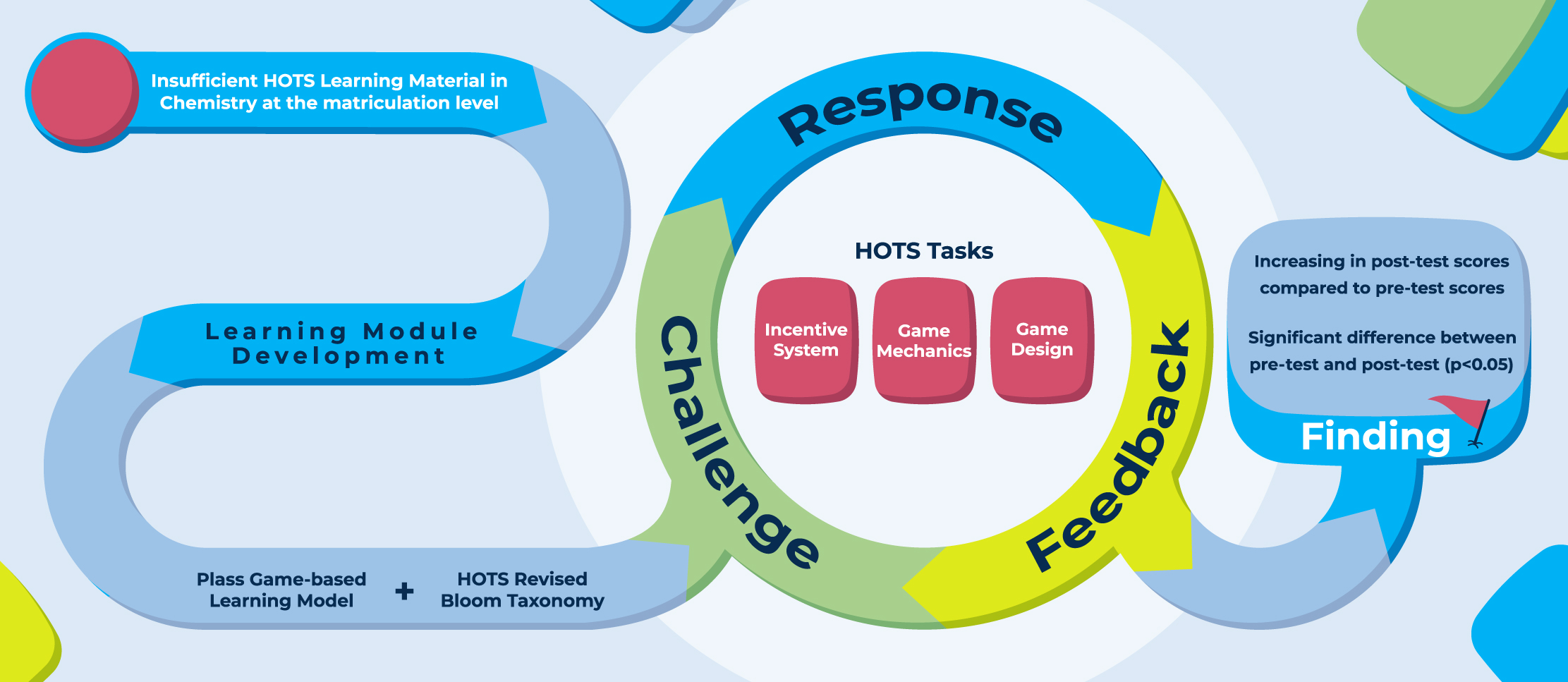
No aprendizado do século XXI, as habilidades de pensamento de ordem superior (HOTS) são essenciais para os alunos matriculados. No entanto, a falta de materiais de HOTS dá aos alunos menos oportunidades de praticar HOTS em química. Este trabalho de pesquisa desenvolveu um módulo de aprendizagem baseado em jogos com base na taxonomia revisada de Bloom e em um modelo de aprendizagem baseado em jogos. O projeto pré-experimental com pré-teste e pós-teste de um grupo foi empregado para medir os efeitos do módulo sobre as habilidades de pensamento de análise, avaliação e criação de HOTS dos alunos, envolvendo 30 alunos da faculdade de matrículas. O resultado mostra um aumento nas pontuações médias no pós-teste em comparação com as pontuações do pré-teste e o teste T de amostra pareada mostra uma diferença significativa entre as pontuações do pré-teste e do pós-teste com p<0,05. As descobertas contribuíram para o potencial da aprendizagem baseada em jogos para promover o HOTS no nível de matrículas e fornecer aos alunos uma aprendizagem de qualidade.
Referências
Aini, F. Q.; Fitriza, Z.; Gazali, F.; Mawardi, M. First-year university students’ understanding of chemical equilibrium. Journal of Physics: Conference Series. 2019, 1280, 032018. https://doi.org/10.1088/1742-6596/1280/3/032018
Anderson, L. W.; Krathwohl, D. R. A Taxonomy for Learning Teaching and Assessing. A Revision of Bloom’s Taxonomy of Educational Objectives. Longman, 2001.
Azid, N.; Md-Ali, R. The effect of the successful intelligence interactive module on universiti utara malaysia students’ analytical, creative and practical thinking skills. South African Journal of Education. 2020, 40 (3), 1–11. https://doi.org/10.15700/saje.v40n3a1743
Bello, S.; Ibi, M. B.; Bukar, I. B. Effect of Simulation Techniques and Lecture Method on Students' Academic Performance in Mafoni Day Secondary School Maiduguri, Borno State, Nigeria. Journal of Education and Practice. 2016, 7 (23), 113–117.
Chen, S. Y.; Tsai, J. C.; Liu, S. Y.; Chang, C. Y. The effect of a scientific board game on improving creative problem solving skills. Thinking Skills and Creativity. 2021, 41, 100921. https://doi.org/10.1016/J.TSC.2021.100921
Cohen, L.; Manion, L.; Morrison, K. Research Methods in Education. Routledge, 2017. https://doi.org/10.4324/9781315456539
Farihah, M. J.; Norawi, A. M.; Jahan, A. N. Game-Based STEM Module Development for KSSM Science Teachers. Journal of Turkish Science Education. 2021, 18 (2), 249–262. https://doi.org/10.36681/tused.2021.63
Ichsan, I. Z.; Sigit, D. V.; Miarsyah, M.; Ali, A.; Arif, W. P.; Prayitno, T. A. HOTS-AEP: Higher order thinking skills from elementary to master students in environmental learning. European Journal of Educational Research. 2019, 8 (4), 935–942. https://doi.org/10.12973/eu-jer.8.4.935
Jamal, S. N. B.; Ibrahim, N. H. B.; Halim, N. D. B. A.; Alias, M. I. B. A preliminary study on the level of creativity among chemistry students in district of melaka tengah. Journal of Critical Reviews. 2020, 7 (16), 752–761. https://doi.org/10.31838/jcr.07.16.88
Johnson, R. B.; Christensen, L. Educational research: Quantitative, qualitative, and mixed approaches. Sage publications, 2019.
Khamhaengpol, A.; Phewphong, S.; Chuamchaitrakool, P. STEAM Activity on Biodiesel Production: Encouraging Creative Thinking and Basic Science Process Skills of High School Students. Journal of Chemical Education. 2021, 99 (2), 736–744. https://doi.org/10.1021/acs.jchemed.1c00874
Misrom, N. S.; Abdurrahman, M. S.; Abdullah, A. H.; Osman, S.; Hamzah, M. H.; Fauzan, A. Enhancing students’ higher-order thinking skills (HOTS) through an inductive reasoning strategy using geogebra. International Journal of Emerging Technologies in Learning. 2020, 15 (3), 156–179. https://doi.org/10.3991/ijet.v15i03.9839
Noh, S. C.; Karim, A. M. A. Design thinking mindset to enhance education 4.0 competitiveness in Malaysia. International Journal of Evaluation and Research in Education. 2021, 10 (2), 494–501. https://doi.org/10.11591/ijere.v10i2.20988
Patiño, A.; Ramírez-Montoya, M. S.; Buenestado-Fernández, M. Active learning and education 4.0 for complex thinking training: analysis of two case studies in open education. Smart Learning Environments. 2023, 10 (8). https://doi.org/10.1186/s40561-023-00229-x
Plass, J. L.; Homer, B. D.; Kinzer, C. K. Foundations of Game-Based Learning. Educational Psychologist. 2015, 50 (4), 258–283. https://doi.org/10.1080/00461520.2015.1122533
Plass, J. L.; Homer, B. D.; Mayer, R. E.; Kinzer, C. K. Theoretical Foundations of Game-Based and Playful Learning. In Handbook of game-based learning. 2020.
Rokhim, D. A.; Septiani, M. O. Development of Triple Representation Based on Virtual Laboratory Media on the Chemical Equilibrium Experiment in Online Learning Era. Journal of Educational Chemistry. 2021, 3 (2), 111–122. https://doi.org/10.21580/jec.2021.3.2.7809
Saban, A. Curriculum development through action research: A model proposal for practitioners. Pegem Egitim ve Ogretim Dergisi. 2021, 11 (1), 299–354. https://doi.org/10.14527/PEGEGOG.2021.009
Sasson, I.; Yehuda, I.; Miedijensky, S.; Malkinson, N. Designing new learning environments: An innovative pedagogical perspective. Curriculum Journal. 2022, 33 (1), 61–81. https://doi.org/10.1002/curj.125
Tangkui, R.; Keong, T. C. Enhancing Pupils’ Higher Order Thinking Skills Through the Lens of Activity Theory: Is Digital Game-Based Learning Effective? International Journal of Advanced Research in Education and Society. 2020, 2 (4), 1–20.
Tong, L. C.; Rosli, M. S.; Saleh, N. S. Enhancing HOTS using Problem-Based Learning and Digital Game in the Context of Malaysian Primary School. International Journal of Interactive Mobile Technologies. 2022, 16 (2), 1–20. https://doi.org/10.3991/ijim.v16i02.27677
Wan, Y.; Yao, R.; Li, Q.; Bi, H. Views of Chinese middle school chemistry teachers on critical thinking. Chemistry Education Research and Practice. 2022, 24 (1), 161–175. https://doi.org/10.1039/d2rp00237j

Este trabalho está licenciado sob uma licença Creative Commons Attribution 4.0 International License.
Copyright (c) 2025 Eclética Química