
Keywords
chemistry
students’ achievement
How to Cite




Abstract
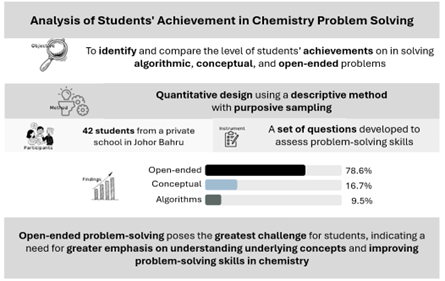
This study analyses students’ achievements level in solving chemistry problems. Questions were designed in algorithm, conceptual and open-ended formats. The limited research on students’ effectiveness in different problem types highlights the need to examine their grasp fundamental chemistry concepts. This research aims to identify and compare achievements levels across the three problems types. A quantitative design using a paper-and-pencil test was employed. The instrument, covering mole concept, acid base, and polymer topics, was administered to 42 high school chemistry students from private school in Johor Bahru through purposive sampling. Descriptive statistics including frequency and percentage, were used to summarize the achievement level. Data were analyzed using SPSS 27.0. Findings shows that open-ended problems recorded the highest low achievement rate (78.6%), compared to algorithmic (9.52%) and conceptual problems (16.7%). These results indicate that open ended problems are the most difficult for students to master, reflecting weaknesses in understanding underlying concepts. Greater emphasis on cultivating problem solving culture in classrooms is recommended.
References
Authority, S. Q. Chemistry open-ended questions support materials. Learning and Teaching Scotland, 2010.
Azahar, S.; Cheng, C. Understanding Malaysia’s decline in PISA scores: causes and consequences. Institute of Strategic & International Studies (ISIS) Malaysia, 2024.
Aziza, M. A Teacher Questioning Activity: The Use of Oral Open-Ended Questions in Mathematics Classroom. Qual. Res. Educ. 2021, 10 (1). 31-61. https://doi.org/10.17583/qre.2021.6475
Bayarcal, G. C.; Tan, D. A. Students’ Achievement and Problem Solving Skills in Mathematics through Open-Ended Approach. Am. Educ. Res. J. 2023, 11 (4), 183–190. https://doi.org/10.12691/education-11-4-2
Black, P. Helping students to become capable learners. Eur. J. Educ. 2018, 53 (2), 144–159. https://doi.org/10.1111/ejed.12273
Broman, K. Engagement and relevance through context-based, everyday life, open-ended chemistry problems, Chapter 4, In: Advances in Chemistry Education Series, 2020 ebook collection. 2020, p. 52-72. https://doi.org/10.1039/9781788016087-00052
Carpenter, S. K.; Witherby, A. E.; Tauber, S. K. On students’(mis) judgments of learning and teaching effectiveness. J. Appl. Res. Mem. Cogn. 2020, 9 (2), 137–151. https://doi.org/10.1016/j.jarmac.2019.12.009
Chophel, Y. Remediating misconceptions related to particulate nature of matter using video animation: An action research. Intern. Res. J. Sci. Technol. Manag. 2022, 2 (1), 65–77. https://doi.org/10.5281/zenodo.649677
Cracolice, M. S.; Deming, J. C.; Ehlert, B. Concept Learning versus Problem Solving: A Cognitive Difference. J. Chem. Educ. 2008, 85 (6), 873. https://doi.org/10.1021/ed085p873
Csernoch, M.; Biró, P.; Máth, J. Developing computational thinking skills with algorithm-driven spreadsheeting. IEEE Access. 2021, 9, 153943–153959. https://doi.org/10.1109/ACCESS.2021.3126757
Diaz, B.; Aizman, A. Design and impact of a stoichiometry voluntary online course for entering first-year STEM college students. Chemistry Education Research and Practice. 2024, 25 (1), 11-24.
Ely, L. L. Mastery learning of chemistry competencies through the spiral progression approach in curriculum. Int. J. Educ. Sci. Res. 2019, 9 (5), 2–28.
Emara, M.; Hutchins, N. M.; Grover, S.; Snyder, C.; Biswas, G. Examining Student Regulation of Collaborative, Computational, Problem-Solving Processes in Open-Ended Learning Environments. J. Learning Analytics. 2021, 8 (1), 49–74.
Fitriana, L. D.; Fuad, Y.; Ekawati, R. Student’s Critical Thinking in Solving Open-Ended Problems based on Their Personality Type. J. Phys.: Conf. 2018, 947, 012007. https://doi.org/10.1088/1742-6596/947/1/012007
Frank, D. V.; Baker, C. A.; Herron, J. D. Should students always use algorithms to solve problems? J. Chem. Educ. 1987, 64 (6), 514. https://doi.org/10.1021/ed064p514
Frey, R. F.; Brame, C. J.; Fink, A.; Lemons, P. P. Teaching Discipline-Based Problem Solving. CBE Life Sci. Educ. 2022, 21 (2), fel1–9. https://doi.org/10.1187/cbe.22-02-0030
Hagos, T. Progressivism in chemistry education: Emphasizing student-centered learning and real-world relevance. African J. Chem. Educ. 2025, 15 (1), 147–179.
Haláková, Z.; Proksa, M. Two kinds of conceptual problems in chemistry teaching. J. Chem. Educ. 2007, 84 (1), 172–174. https://doi.org/10.1021/ed084p172
Hennink, M.; Kaiser, B. N. Sample sizes for saturation in qualitative research: A systematic review of empirical tests. Soc. Sci. Med. 2022, 292, 114523. https://doi.org/10.1016/j.socscimed.2021.114523
Hill, V. (2020). Polymer chemistry education to increase student awareness of plastic pervasiveness and environmental impact. Eastern Michigan University.
Hurrel, D. P. Conceptual Knowledge or Procedural Knowledge or Conceptual and Procedural Knowledge: Why the Conjunction is important for teachers. Aust. J. Teach. Educ. 2021, 46 (2), 57–71. https://doi.org/10.14221/ajte.2021v46n2.4
Jamil, M.; Bokhari, T. B.; Zia, Q. Qualitative content analysis for critical thinking and skill development: A case of chemistry curriculum. Journal of Asian Development Studies. 2024, 13 (1), 147–155.
Kinge, T. R.; Wiysahnyuy, L. F.; Awah, T. M.; Nkuo-Akenji, T. Current statistics in Science, Technology and Innovation in higher education in Cameroon and the establishment of gender participation. African Journal of Rural Development. 2020, 5 (3), 105–142.
Komildjanovna, N. M. The power of open-ended question and its crucial role in discovering unanticipated answers, gathering additional details and important insights. Web Teach. 2024, 2 (10), 33–45.
Ly, B. N.; Tran, K. D. T.; Huynh, N. T. The potential of Malaysia in achieving the top-third position in PISA. J. Soc. Transform. Educ. 2022, 3 (2), 67–79.
Nedjat-Haiem, M.; Cooke, J. E. Student strategies when taking open-ended test questions. Cogent Education. 2021, 8 (1), 1877905. https://doi.org/10.1080/2331186X.2021.1877905
Olubunmi, O. A. Effectiveness of problem of solving approach on gender related differences in teaching secondary school chemistry students mathematical concepts of chemistry in Ondo state, Nigeria. Eur. J. Educ. Stud. 2016, 2 (10), 52–60.
Rahmawati, Y.; Hartanto, O.; Falani, I.; Iriyadi, D. Students’ Conceptual Understanding in Chemistry Learning Using PhET Interactive Simulations. J. Technol. Sci. Educ. 2022, 12 (2), 303–326. https://doi.org/10.3926/jotse.1597
Raman, Y.; Surif, J.; Ibrahim, N. H. The Effect of Problem Based Learning Approach in Enhancing Problem Solving Skills in Chemistry Education: A Systematic Review. International Journal of Interactive Mobile Technologies. 2024, 18 (5), 91–111. https://doi.org/10.3991/ijim.v18i05.47929
Rau, M. A.; Zahn, M.; Misback, E.; Herder, T.; Burstyn, J. Adaptive support for representational competencies during technology-based problem solving in chemistry. J. Learn. Sci. 2021, 30 (2), 163–203. https://doi.org/10.1080/10508406.2021.1888733
Rosa, V.; Corrales, A.; Nguyen, Y.; Atkinson, M. B. Relevance and equity: should stoichiometry be the foundation of introductory chemistry courses? Chem. Educ. Res. Pract. 2022, 23 (3), 662–685. https://doi.org/10.1039/D1RP00333J
Sangguroa, S. A.; Surifa, J. A conceptual framework for enhancing problem solving skills in chemistry. J. Phys.: Conf. Ser. 2021, 1842, 012046. https://doi.org/10.1088/1742-6596/1842/1/012046
Sarwari, K.; Kakar, A. F. Developing students’ critical thinking skills through contextual teaching and learning. J. Cogn. Emot. Educ. 2023, 1 (1), 29–42.
Sausan, I.; Saputro, S.; Indriyanti, N. Chemistry for Beginners: What Makes Good and Bad Impression. Adv. Intell. Syst. Res. 2018, 157, 42–45. https://doi.org/10.2991/miseic-18.2018.11
Shanta, S.; Wells, J. G. T/E design-based learning: assessing student critical thinking and problem solving abilities. Int. J. Technol. Des. Educ. 2022, 32 (1), 267–285. https://doi.org/10.1007/s10798-020-09608-8
Surif, J.; Ibrahim, N. H.; Dalim, S. F. Problem solving: Algorithms and concept ual and open-ended problems in chemistry. Procedia Soc. Behav. Sci. 2014, 116, 4955–4963. https://doi.org/10.1016/j.sbspro.2014.01.1055
Tornee, N.; Bunterm, T.; Lee, K.; Muchimapura, S. Examining the effectiveness of guided inquiry with problem-solving process and cognitive function training in a high school chemistry course. Pedagogies: An International Journal. 2019, 14 (2), 126–149. https://doi.org/10.1080/1554480X.2019.1597722
Tóthová, M.; Rusek, M.; Chytrý, V. Students’ Procedure When Solving Problem Tasks Based on the Periodic Table: An Eye-Tracking Study. J. Chem. Educ. 2021, 98 (6), 1831–1840. https://doi.org/10.1021/acs.jchemed.1c00167
Tóthová, M.; Rusek, M. Developing Students’ Problem-Solving Skills Using Learning Tasks: An Action Research Project in Secondary School. Acta Chim. Slov. 2021, 68 (4), 1016–1026. https://doi.org/10.17344/acsi.2021.7082
Tsaparlis, G. Problems and Problem Solving in Chemistry Education: Analysing Data, Looking for Patterns and Making Deductions (No. 7). Royal Society of Chemistry, 2021. https://doi.org/10.1039/9781839163586
Vo, K.; Sarkar, M.; White, P. J.; Yuriev, E. Problem solving in chemistry supported by metacognitive scaffolding: teaching associates’ perspectives and practices. Chem. Educ. Res. Pract. 2022, 23 (2), 436–451. https://doi.org/10.1039/D1RP00242B
Vo, K.; Sarkar, M.; White, P. J.; Yuriev, E. Development of problem-solving skills supported by metacognitive scaffolding: insights from students’ written work. Chem. Educ. Res. Pract. 2024, (4), 1197–1209. https://doi.org/10.1039/d3rp00284e
Yaman, F.; Ayas, A.; Çalik, M. Facilitating grade 11 students’ conceptual understanding of fundamental acid-base models. Turkish J. Educ. 2019, 8 (1),16–32. https://doi.org/10.19128/turje.449100

This work is licensed under a Creative Commons Attribution 4.0 International License.
Copyright (c) 2025 Eclética Química